
Drone Surveys — Orthomosaics, Point Clouds and CAD Outputs
Drone surveys provide a fast, safe, and cost-effective way to capture accurate site data for construction and engineering projects. Using survey-grade UAVs, Sky Scan Surveys delivers drone survey outputs that support design coordination, measurement, inspection, and decision-making without the need for scaffolding, road closures, or extended site access.
Our drone surveys are used by project managers, engineers, and consultants who need defensible data, clear accuracy statements, and CAD-ready deliverables they can rely on for design, verification, and reporting. Each survey is planned and delivered based on site conditions, required accuracy, and intended use — not a one-size-fits-all approach.
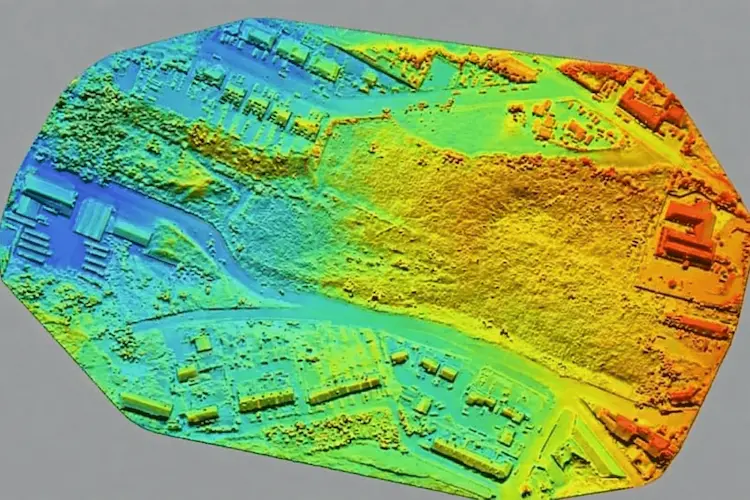
What Are Drone Surveys?
A drone survey uses unmanned aerial vehicles (UAVs) to capture aerial data that is processed into measurable outputs such as orthomosaics, point clouds, surface models, and inspection imagery. Unlike visual drone flights, survey drone work is planned, controlled, and processed to produce scaled data suitable for engineering and construction use.
Drone surveys are commonly used where traditional surveying methods are slower, higher risk, or impractical — such as large sites, live construction environments, roofs, façades, infrastructure corridors, and hard-to-access areas. Depending on project requirements, drone surveys may be used independently or integrated with ground control and terrestrial survey methods.
Deliverables are issued with clear scope, limitations, and accuracy statements so the data can be used confidently within design and construction workflows.
Benefits of Drone Surveys
Drone surveys offer practical advantages for construction and engineering teams:
Reduced site risk
no need for working at height or temporary access
Faster data capture
large areas surveyed in hours rather than days
Cost efficiency
reduced access costs and repeat site visits
Accurate measurement
scaled outputs suitable for CAD and reporting
Minimal disruption
surveys completed with limited impact on site operations
Clear deliverables
issued data with defined accuracy and limitations
Drone surveys are particularly effective where access, time, or safety constraints make traditional methods inefficient.
Technology & Accuracy
We deploy survey-grade UAV platforms and processing workflows appropriate to construction and engineering use.
| Typical accuracy ranges | (subject to site conditions and control): |
|---|---|
| Horizontal: | ±20–30 mm |
| Vertical: | ±30–40 mm |
Accuracy statements are provided with every drone survey.
Where higher accuracy is required — for example, design coordination or setting-out verification — drone surveys can be integrated with a site control network. By establishing control, applying least-squares adjustment, and referencing the point cloud to the control network, **sub-10 mm accuracy can be achieved** in suitable conditions. This approach is particularly useful where drone data is being used to support design or verification rather than general measurement.
Survey Methods Used in Drone Surveys
Drone surveys are not a single method. The appropriate technique is selected based on site conditions and project requirements.
Photogrammetry is the primary method for most drone surveys. Overlapping aerial imagery is processed into orthomosaics, point clouds, and surface models – suitable for topographic mapping, volumetric calculations, progress monitoring, and design coordination. See our drone land survey service.
LiDAR is used where photogrammetry struggles – vegetated sites, dense canopy, or complex terrain requiring bare-earth ground returns. See our LiDAR survey services.
Thermal imaging is used for inspection work rather than measurement – roof defect identification, moisture ingress, and solar PV inspections. See our – drone roof inspection service.
Visual inspection capture is often carried out alongside metric surveys to support condition assessment and reporting. Outputs are non-metric but provide useful context for project records – See our drone roof inspection service.
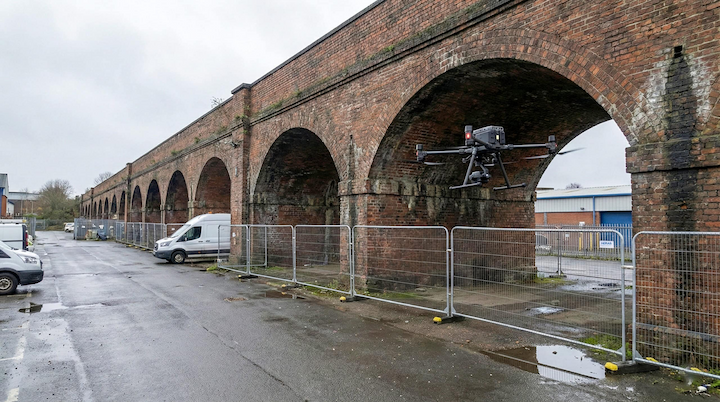
Applications & Use Cases
Drone surveys are used across a wide range of construction and engineering scenarios:
- Construction sites — progress tracking, verification, reporting
- Infrastructure projects — corridors, highways, utilities
- Roof & façade surveys — safe access to elevated structures
- Earthworks & stockpiles — volume measurement and monitoring
- Design coordination — context data for CAD and BIM workflows
- Solar PV installations — inspection and performance analysis
Each application is assessed individually to ensure the chosen method and outputs are appropriate.
Project Evidence
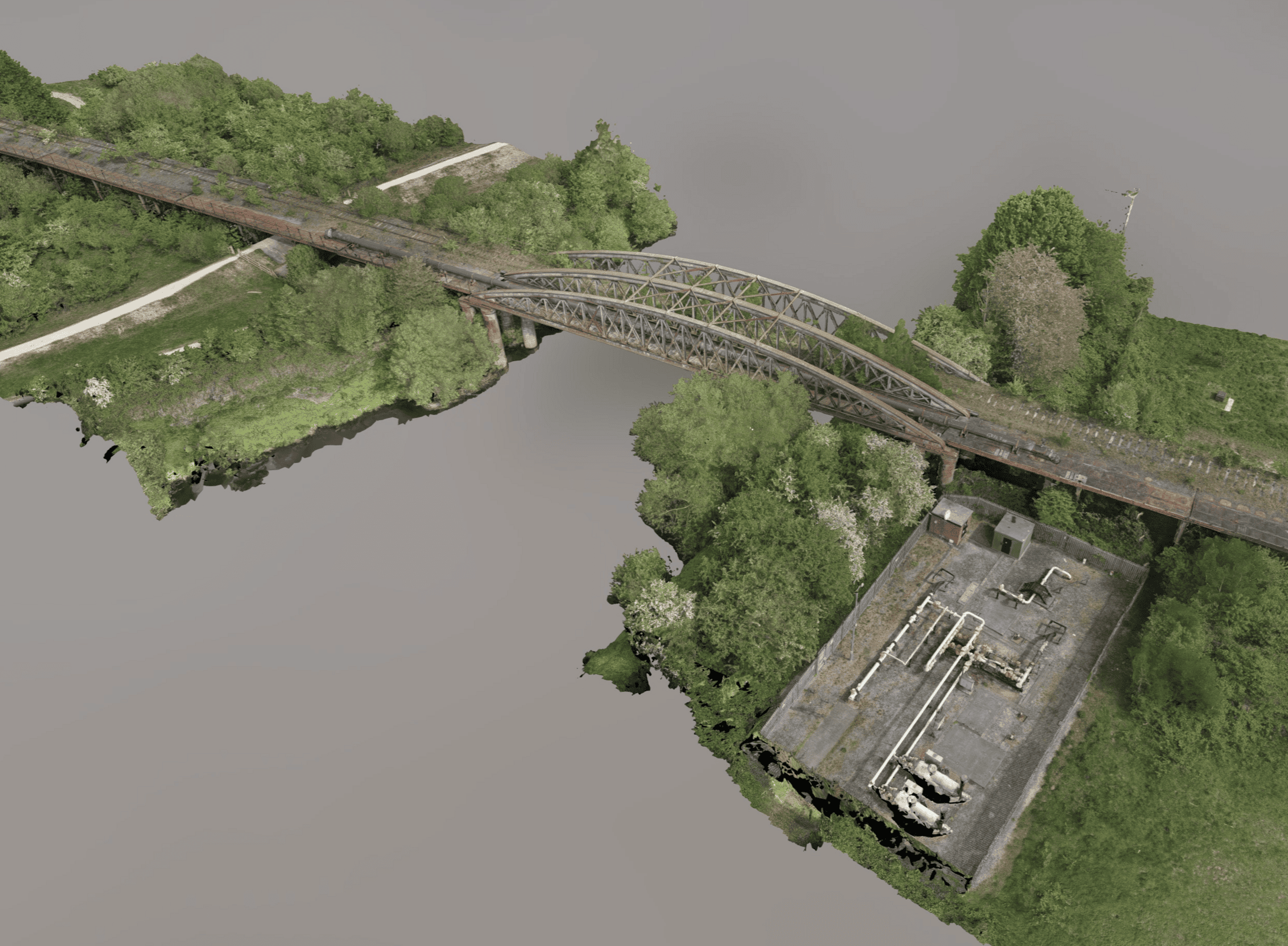
Wheldale Viaduct, Castleford, West Yorkshire
Client: A regional infrastructure consultancy | Sector: Rail Infrastructure, Heritage
Context: A council engineering team needed a structural condition survey of a Grade II listed multi-span canal viaduct to inform maintenance planning — but traditional rope access and scaffolding would have been prohibitively expensive for a preliminary assessment, and physical contact with the heritage structure carried risk.
- Georeferenced orthomosaic covering all spans
- Dense 3D point cloud (classified .LAZ, 16GB)
- .RCS file for direct Revit import (9GB)
- Navigable 3D model via online viewer
- Accuracy report with ground control coordinates
- Sub-20mm positional accuracy achieved (Total RMS: 1.65cm)
- Full structural survey delivered without scaffolding or physical access
- Engineering team conducted remote condition review before deciding on invasive inspection scope
Method: DJI M300 RTK + Zenmuse P1 | EDM control network with 6–8 GCPs | Total station traverse
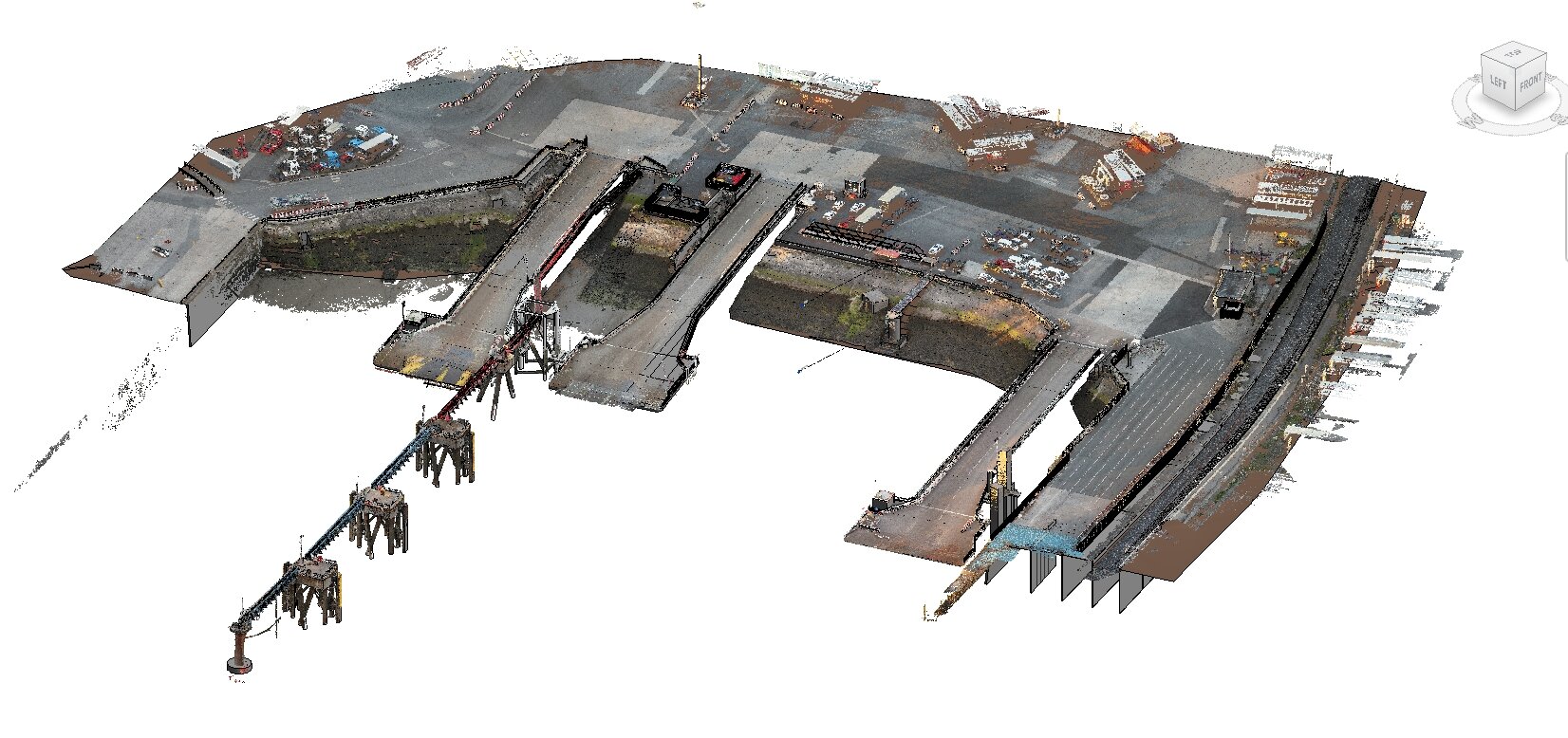
Heysham Dock, Lancashire
Client: An international marine energy contractor | Sector: Marine, Energy
Context: A contractor working on critical energy infrastructure at an active port needed aerial survey data to support construction planning — but the port environment with vessel movements, crane operations and restricted airspace made conventional drone operations high-risk.
- Comprehensive aerial survey dataset
- Positional accuracy maintained despite electromagnetic interference from heavy plant
- Survey completed within tightly controlled operational window
- CAA Nuclear Exemption (AR-2025-2498 NEXM) obtained and approved
- Survey data delivered on programme with no disruption to port operations
- Harbour master coordination and flight risk assessment completed for port-specific hazards
Method: Survey-grade drone with dual-frequency GNSS ground control | Full port risk assessment and harbour master coordination
Our Drone Survey Process
We follow a structured, professional workflow to ensure drone survey data is reliable and fit for purpose:
Project scoping
Flight planning & permissions
Airspace checks, risk assessments, and method selection are completed prior to site attendance.
Site data capture
UAV data is captured using survey-grade platforms, with ground control introduced where required.
Processing & QA
Data is processed into scaled outputs and cross-checked for consistency and accuracy.
Deliverables issued
Final outputs are supplied in agreed formats with accuracy and limitations clearly stated.
Each project is delivered with a level of detail appropriate to its use — whether for measurement, inspection, coordination, or reporting.
Pricing & Service Options
| Service | Price Range |
|---|---|
| Drone land survey — site mapping and terrain Orthomosaic, DTM, point cloud, contours | £599 – £5,499 / POA |
| UAV LiDAR survey Classified point cloud, DTM/DSM, bare-earth model | £1,199 – £3,499 |
| Terrestrial LiDAR — single structure or building Registered point cloud, E57/RCP output | £799 – £1,499 |
| Combined UAV + terrestrial LiDAR Wide-area terrain + high-density structural capture | £1,999 – £3,999 |
| Drone roof inspection HD imagery, annotated condition report | £349 – £699+ |
| Measured building survey Floor plans, elevations, sections, point cloud | £1,199 – £7,499+ |
| Engineering-grade survey with accuracy report Ground control network, LSA, OSGB36 or project CRS | Quote required |
All pricing includes data processing and professional reporting. Formal quotes are issued once scope and outputs are confirmed.
Why Choose Sky Scan Surveys
Construction-grade drone surveys
Survey data produced for engineering, design, and construction applications — not hobbyist drone work. Outputs are project-referenced and QA-checked before issue.
CAA-authorised and fully insured
All flights operated under CAA authorisation with £5m public liability insurance and £1m professional indemnity cover, with higher limits available where required.
RICS-trained surveyors
Drone capture supported by professional survey control and construction experience, not operated in isolation from proper survey practice.
Accurate, CAD-ready outputs
Georeferenced orthomosaics, DTMs, point clouds, and contour data delivered in formats your design team can use directly.
UK-wide rapid mobilisation
Site visits scheduled across the UK with typical delivery within 5–10 working days depending on scope.
Trusted By









Our Certifications and Memberships






Frequently Asked Questions
How accurate are drone surveys?
Typical drone survey accuracy is ±20–30 mm horizontally and ±30–40 mm vertically. Higher accuracy (sub-10 mm) can be achieved by integrating ground control networks where required.
Are drone surveys suitable for design work?
Drone surveys can support design coordination, particularly when combined with control. Suitability depends on project requirements and tolerance levels.
What deliverables do you provide?
Deliverables may include orthomosaics, point clouds, surface models, inspection imagery, and CAD-ready outputs, depending on scope.
How long does a drone survey take?
Most sites are surveyed within a day. Processing and delivery times vary depending on data volume and outputs, typically 5-10 working days.
Do you work on live construction sites?
Yes. Drone surveys are commonly used on active sites to minimise disruption and reduce risk.