
- Home >
- Topographic Surveys
Topographic survey service · UK
Topographic Surveys — CAD Plans, Contours and Site Data
Topographic surveys capture the ground truth of a site — surface levels, features, boundaries, and infrastructure positions — so that engineers and designers can work from accurate, referenced data rather than assumptions. Sky Scan Surveys provides topographic surveys across the UK with documented accuracy statements and coordinate system reference suitable for design coordination and setting out.
Whether you need a topo survey for a pre-construction design package, earthworks verification, or an as-built record, the process starts with understanding what decisions the data needs to support and what tolerances the project actually requires.

What is recorded
Ground levels, building positions, boundaries, trees, drainage runs, kerb lines, overhead cables, and any other features that affect design or construction.
Capture methods
GNSS for control, total station for detail, drone for wider context — with outputs merged in processing. Laser scanning where point cloud density matters.
Output formats
DWG, DXF, Revit (RVT), IFC, LAS, and E57. Where clients have specific CAD standards or layer naming conventions, we process to those requirements.
Issued with every survey
A documented accuracy statement, stated limitations, and coordinate system reference. Deliverables are version-controlled so that revisions are tracked.
S3 · Scope
What a topographic survey covers
In practice, the scope depends on what the data will be used for. A topo for drainage design needs accurate invert levels and falls. A topo for earthworks needs reliable surface modelling across a wider area. A topo feeding into BIM needs feature coding that translates cleanly into Revit families. We establish the intended use before mobilising, because that determines the method, detail level, and control requirements.
Common site detail
- Ground levels and surface levels
- Building positions
- Boundaries
- Trees
- Drainage runs
- Kerb lines
- Overhead cables
- Infrastructure positions
Detail to specify at scoping
- Intended use of the data
- Accuracy tolerances required by the project
- Coordinate system, or an existing site grid / local TBM
- Deliverable formats and CAD layer standards
- Drainage invert levels and falls, where drainage design is the use
- Extent of surface modelling, where earthworks volumes are the use
- Feature coding, where the data feeds a BIM model
Not included automatically
- Structural assessments
- Invasive investigations
- Underground services
- Hidden defects
Underground services, hidden defects, and subsurface conditions are not detected by non-invasive survey methods. Data is suitable for design coordination and setting out within defined tolerances — not beyond them.
S4 · Deliverables
What the project team receives
The data is processed and delivered in industry-standard formats including DWG, Revit, and point cloud files, referenced to OSGB36 or a site-specific coordinate system with stated accuracy tolerances.
DWG contour plans and spot height
grids
Contours and spot levels generated from controlled surface models, drafted to the project’s CAD standards.
Feature-coded survey data for CAD and BIM
Feature coding, layering, and version control applied in processing. Where BIM deliverables are required, data is structured for direct import.
Control network reports and coordinate schedules
Control, residuals and acceptance checks reported so the design team can see what the data is anchored to.
Evidence sequence · real world → capture / data → finished deliverable
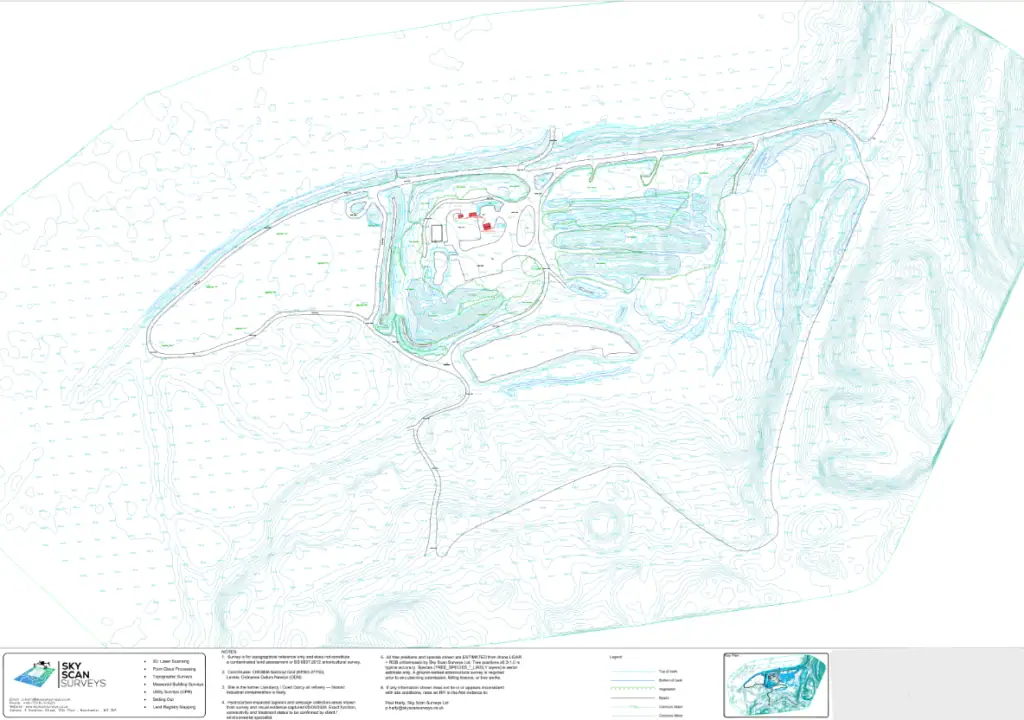
Evidence slot 1

Evidence slot 2
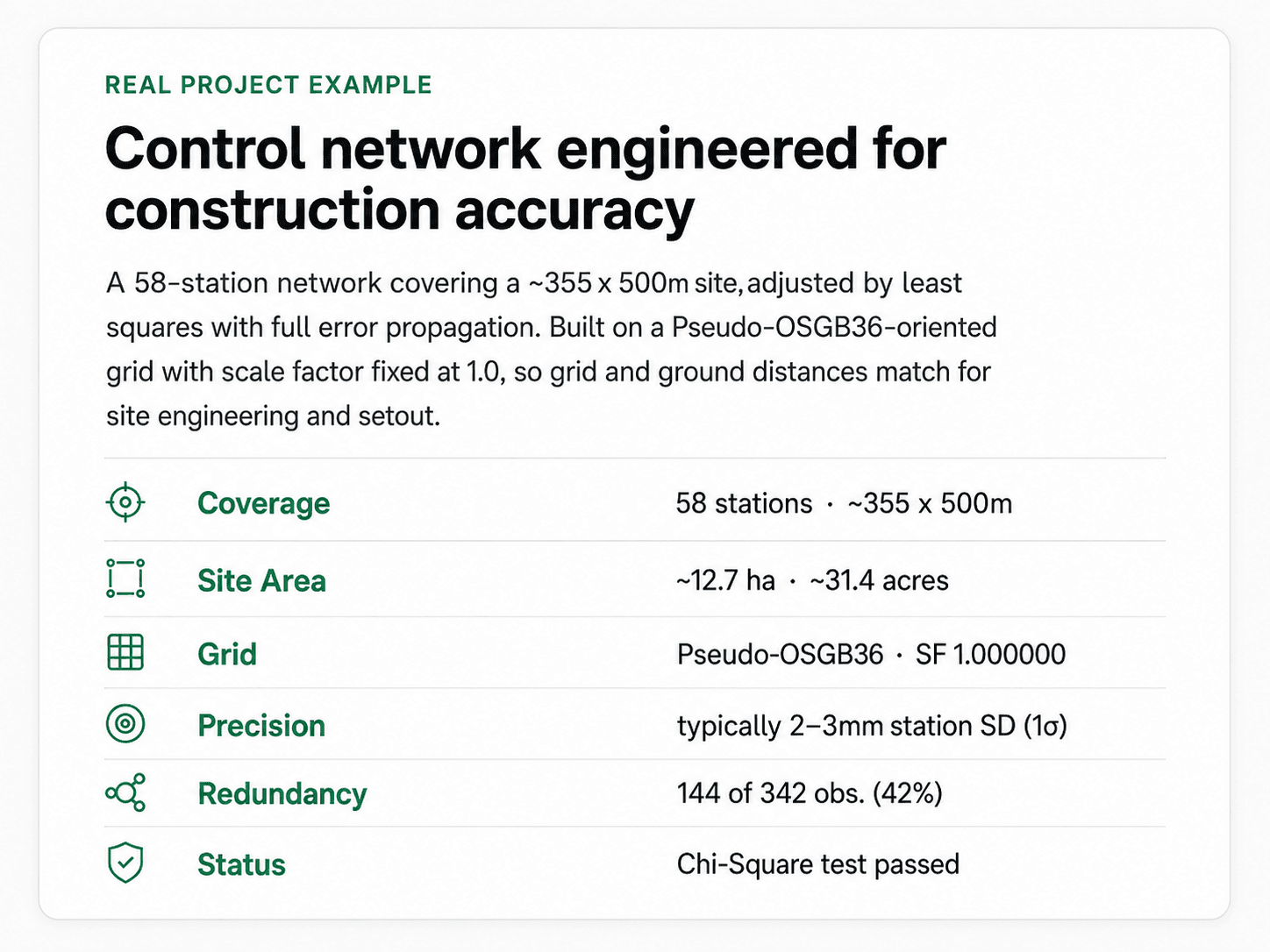
Evidence slot 3
S5 · SSS Interactive Proof Viewer
Inspect a delivered survey model
The interactive model shows a delivered survey in the browser: surface, features and control in the same coordinate reference as the issued CAD.
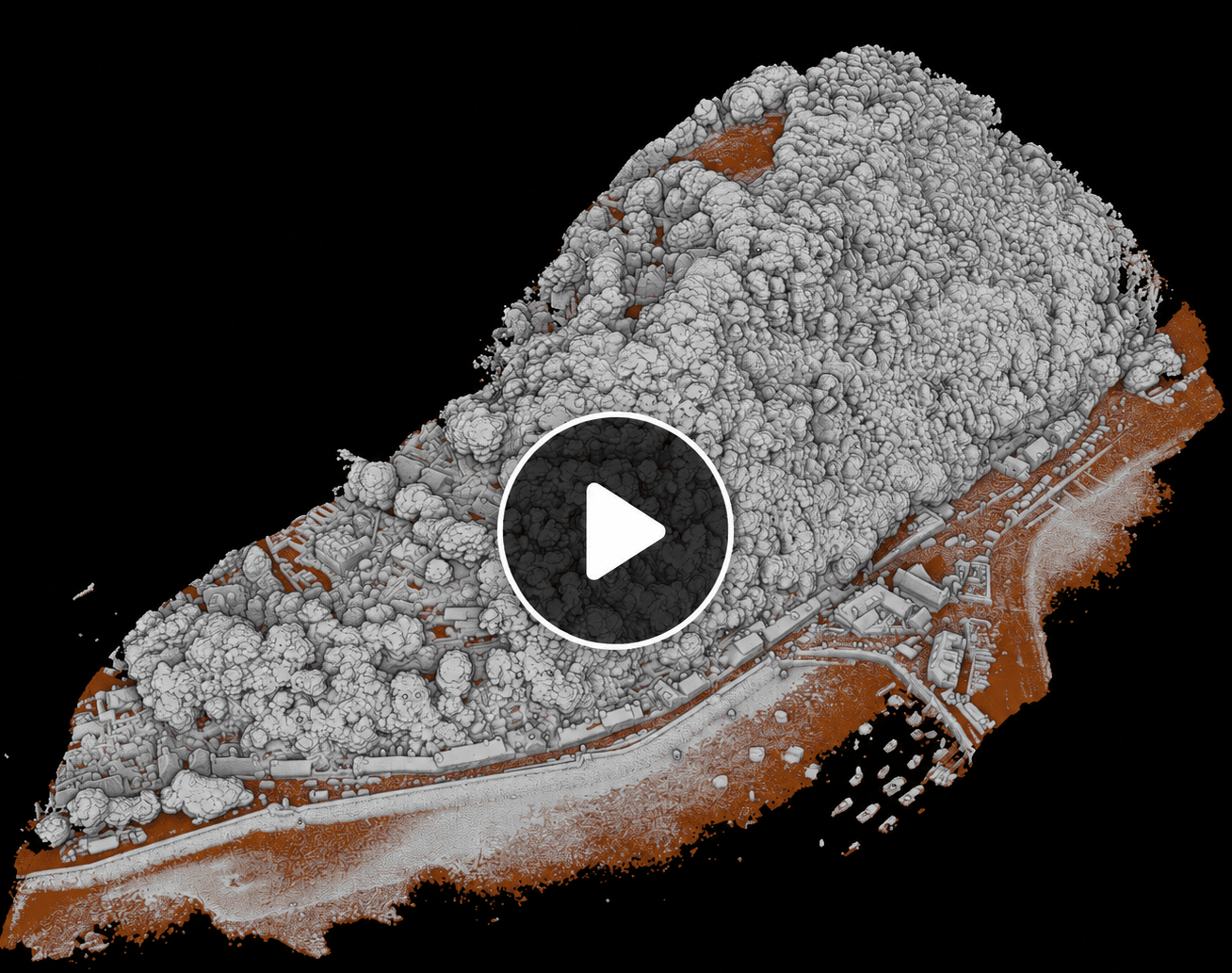
Loading the model contacts a third-party viewer host. Poster and written description remain available if you do not.
S6 · Method and quality control
How the survey is produced and checked
We follow a structured workflow because topographic survey data needs to be defensible — it feeds directly into design, quantities, and setting out. Shortcuts at any stage create problems downstream.
01 · Scope
Site requirements review
We confirm accuracy tolerances, coordinate system, deliverable formats, and intended use with the project team. This is where most problems are prevented — agreeing what the data needs to do before we mobilise.
02 · Control
Control establishment
OSGB36 or site-specific control network is established or verified. On sites with an existing control network, we check into it rather than assuming it is correct.
03 · Method
Method selection
The method — GNSS, total station, laser scanning, or drone — is selected based on site conditions, required accuracy, and access constraints. There is no single method that suits every topographic survey.
04 · Capture
Data capture
Survey-grade equipment deployed by experienced personnel. Equipment is calibrated and maintained to manufacturer specifications. Surveys are planned around live site operations, particularly where access windows are limited.
05 · Process / check
Processing and QA verification
Raw data is processed to client CAD standards with feature coding, layering, and version control applied. Cross-checks are performed against the control network and known site benchmarks. Any discrepancies outside tolerance are investigated and resolved before issue.
06 · Delivery
Delivery
Issued data is provided with an accuracy statement, limitations document, and coordinate system reference. Deliverables are version-controlled so that revisions are tracked.
Surveys are weather-dependent for optimal data quality, particularly where GNSS or drone methods are used. We advise on realistic scheduling at the scoping stage.
S7 · Accuracy, coordinates and constraints
Accuracy is set by the project, not by a headline figure
All data is cross-checked against the control network, so discrepancies are identified before the data reaches the design team. Data is suitable for setting out within the tolerances defined for each project.
What determines it
The quality of the control network the survey is anchored to, and whether an existing network is verified rather than assumed.
GNSS, total station, laser scanning or drone capture — each suits different site conditions and tolerance requirements.
Satellite coverage, vegetation and canopy, access restrictions, built-up or confined areas, and live site operations.
What the deliverable has to do. A contour plan, a volume calculation and a BIM import do not all need the same tolerance.
Surveys do not constitute structural assessments or invasive investigations. Underground services, hidden defects, and subsurface conditions are not detected by non-invasive survey methods.
Coordinates and datum
Surveys default to OSGB36 (Ordnance Survey National Grid) unless project-specific systems are required. We can work to site grids, local TBMs, or client-defined control networks.
Where we are checking into an existing control network, we verify it independently rather than assuming it is correct. Coordinate system and datum are documented in all deliverables.
OSGB36 / British National Grid — default horizontal
ODN — vertical datum
Local / project grid or site TBM — on request
S8 · Buyer fit
Which decisions this survey supports
Topographical surveys are used wherever someone needs reliable, referenced ground data to make a design or construction decision. Primary clients include construction project managers, design managers, civil engineers, BIM coordinators, and surveying consultants.
Pre-construction site design
Providing the base plan that architects, civil engineers, and planners work from — before design assumptions are committed.
Earthworks and cut/fill
Surface models used to calculate volumes, verify quantities, and monitor progress against design.
Drainage design
Accurate invert levels, falls, and cover depths that drainage engineers require for gravity-fed systems.
Highway and infrastructure corridors
Linear surveys for road design, utilities, and transport planning.
As-built verification
Confirming that constructed works match design intent within specified tolerances.
BIM model creation
Feature-coded survey data structured for import into Revit, ArchiCAD, or other BIM platforms.
S10 · Cost and quotation
What changes the cost of a topographic survey
Topographic survey costs depend on site area, required accuracy, deliverable complexity, and mobilisation requirements. Typical projects range from single-visit surveys to multi-phase monitoring programmes. Formal quotes are issued once scope and outputs are confirmed.
Cost drivers
Cost is owned in detail on the dedicated page: how topographic survey cost is built up.
Ready to scope it?
A scoped quotation needs the site, the intended use of the data, and the tolerances the project works to. Everything else we can advise on.
All pricing includes data processing, QA, and professional reporting.
S11 · Service questions
Questions asked at scoping stage
What accuracy can topographic surveys achieve?
Accuracy depends on the method, control network quality, and site conditions. Controlled terrestrial surveys typically achieve ±10–15 mm. Drone photogrammetry delivers ±30–50 mm depending on ground control density — ±50 mm is typical without ground control, improving to ±30 mm with a well-distributed control network. Every survey is delivered with a documented accuracy statement.
What deliverable formats are provided?
Standard deliverables include DWG, DXF, Revit (RVT), IFC, LAS, and E57 formats. Where clients have specific CAD standards or layer naming conventions, we process to those requirements. All files include coordinate system metadata and are version-controlled.
How long does a topographic survey take?
Site time depends on area, complexity, and method. A straightforward half-hectare site might take half a day; a complex multi-building site could take several days. Processing and QA typically add 5–10 working days for standard deliverables. Rush turnarounds are available for critical path projects, subject to resource.
What coordinate system is used?
Surveys default to OSGB36 (Ordnance Survey National Grid) unless project-specific systems are required. We can work to site grids, local TBMs, or client-defined control networks. Where we are checking into an existing control network, we verify it independently rather than assuming it is correct. Coordinate system and datum are documented in all deliverables.
Do you provide site visits for scoping?
Yes. For complex projects — particularly those with access restrictions or specific accuracy requirements — a site visit helps assess the right methodology and provide a realistic quote. For simpler sites, remote scoping using site plans and aerial imagery is often sufficient.
Are contours generated from the survey data?
Yes — generated from controlled surface models where appropriate. Control, residuals and acceptance checks are reported in the QA pack.
S12 · Related guidance
If you need something other than a scoped quotation
Definition and terminology, if you are new to specifying one.
Cost drivers in detail, with worked examples by site area and deliverable.
For large-area coverage, restricted ground access, or progress monitoring.
Method comparison, control, processing and output standards in depth.
Where buried apparatus, not surface topography, is the question.
S13 · Scoped enquiry
Request a scoped survey quote
Tell us the site and what the data has to support. We will come back with a scope, a method, and a quotation against it — not a figure without a basis.
Useful to have ready
- Site location and approximate area
- What the survey has to support
- Any tolerance or CAD standard the project works to
- Existing control or a previous survey, if there is one
Prefer to talk it through first?